History and provenance
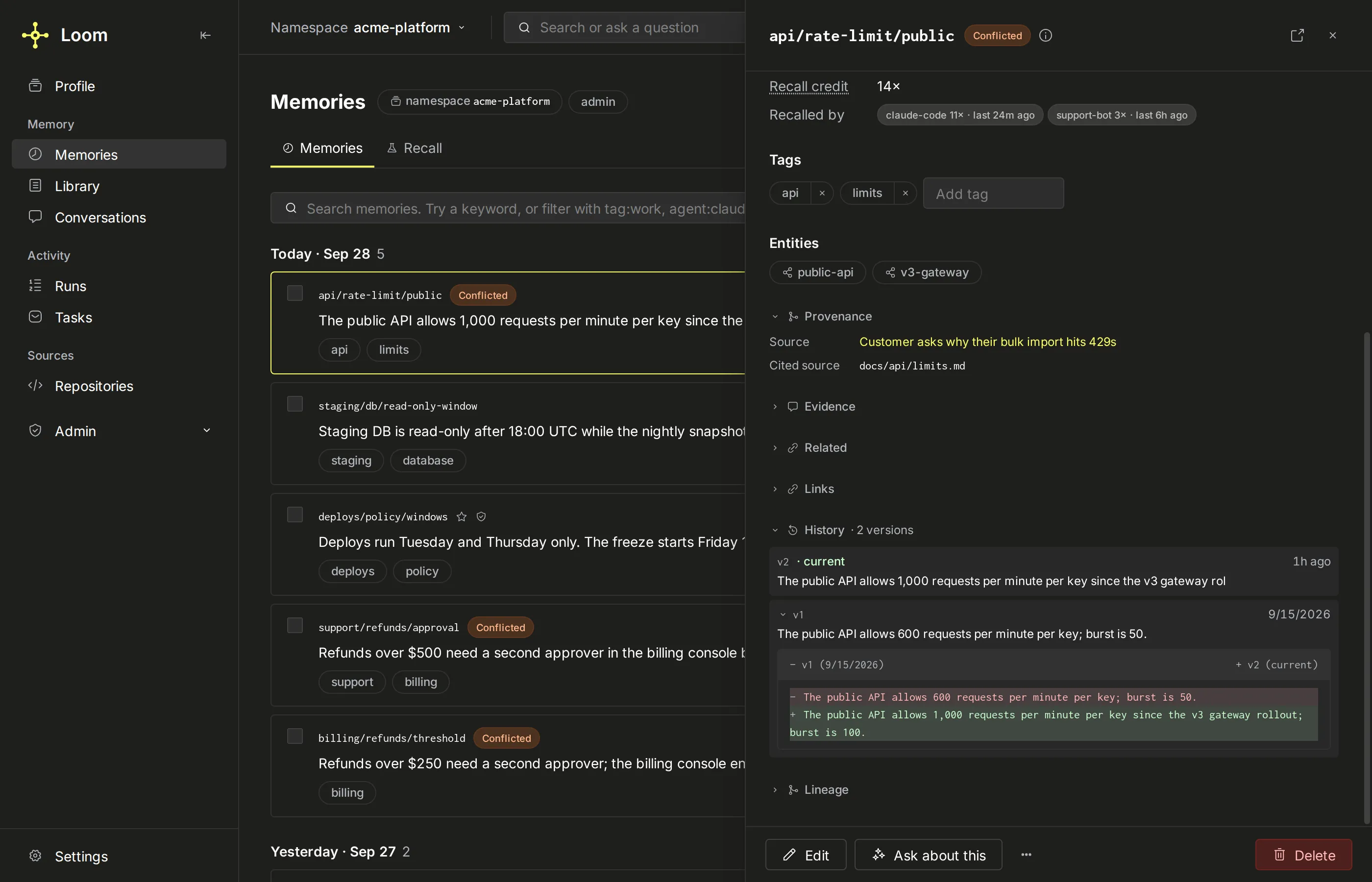
Every write to memory makes a new version; nothing is edited in place. Versions are kept in an append-only mirror, so a fact’s history survives background merges. Each row records who wrote it and how it entered memory, derived rows record their sources, and a person can attest that a row is true. How the version mirror works is in memory architecture.
Operations
| Operation | Role | Answers |
|---|---|---|
memory.history |
viewer | Every version of a key, newest first, including tombstoned and redacted versions. |
memory.provenance |
viewer | Where the live row came from: source trace, writer, source class, the conversation it was extracted from. |
memory.evidence |
viewer | The source turns a fact was extracted from, with the supporting span and how each link was made. |
memory.backlinks |
viewer | What points at a row: versions, digests, typed links in and out, evidence count, entity neighbours. |
memory.lineage |
viewer | The promotion trail of a shared memory: who promoted it, from which rows, through which review. |
memory.verify |
writer | Attest that a row is true as the signed-in person or service account, or revoke the attestation. |
memory.redact |
admin | Scrub the value of one historical version, keeping the row and its audit entry. |
namespace.rollback |
admin | Return every memory head in a namespace to its version at a point in time. |
namespace.snapshot |
admin | Export a namespace’s curated state as a JSON payload. |
namespace.restore |
viewer | Import a snapshot into a fresh namespace, or an existing one the caller administers; never a collection. |
namespace.snapshot and namespace.restore are not MCP tools. Field lists are in the
operations reference under memory and
namespace.
Versions: memory.history
loom.memory holds current state and is read with FINAL, so a merge keeps only the
newest version of each row. loom.memory_versions is an append-only mirror filled by a
materialized view on every insert; it is the history that memory.history,
memory.redact and namespace.rollback read.
A history row carries version (the write’s nanosecond epoch), written_at, value,
confidence, pinned, expires_at, tombstoned_at, redacted_at,
redaction_reason, content_sha256, agent, actor and source_class. created_at
is the row’s first write and repeats on every version. agent="*" spans every writer of
the key.
from loom import Agent

async with Agent(org="acme", namespace="support", agent="auditor") as agent:
    for v in await agent.memory.history("customer/4812/plan", agent_id="*"):
        print(v["written_at"], v["actor"], v["source_class"], v["value"])
A tombstone is a version too, so a delete shows in history and memory.restore can
revive the key within 14 days. For point-in-time reads of current state, use as_of on
memory.get, memory.search and memory.ask
(validity time).
Who wrote it: actor and source class
The server stamps actor (human:<subject> or process:<subject>) and source_class
on every row from the token and the operation. The source_class values are in
memory concepts. A request may only downgrade its class to
external, imported or derived.
memory.provenance returns both, plus:
source_traceand asource_kindderived from it (conversation,extracted,observed,consolidated,app,manual,other);- the
source_resource_idthe writer cited; - the conversation
thread_idandthread_exists(false when the namespace does not record transcripts, or the transcript is gone); - the authored links (
memory.link) touching the row.
Search hits carry source_class and verified, which the optional trust term
(LOOM_MEMORY_SEARCH_TRUST_WEIGHT) reads.
Evidence: which turns a fact came from
Extraction links each fact to its turns in loom.memory_belief_sources.
memory.evidence(memory_key) returns those links with the turn’s text (up to 600
characters), role, time, the supporting span, and how the link was made:
scope |
support_type |
Meaning |
|---|---|---|
cited |
extracted_from |
The extractor named the supporting turn. |
lexical |
lexical_support |
The server matched the fact to its best turn. |
window |
window |
Nothing matched; the whole extraction window is linked. |
derived |
derived_from |
Consolidation lineage: the item is the source memory’s text. |
The response counts links by scope, so a check can tell a cited fact from a loosely tied
one. For a conversation’s exact wording, memory.recall searches the stored turns
(extraction).
Lineage
memory.consolidateand period digests write onederived_fromlink per source intoloom.memory_belief_sources;memory.evidencereturns them asderiveditems.- A session digest lists the keys it compressed (
derived_fromon asummaryhit). memory.lineage(scope="shared") walks a shared memory’s promotion: the event, who promoted it, the supporting rows, the learnings candidate it came from when one matches (match_confidenceexactorinferred), and the audit events.mechanismisreview,import,autoorunknown.memory.backlinksis the inverse: what points at a row.
memory.delete retires a consolidated summary whose sources are all gone and downgrades
one with surviving sources to conflicted.
Attestation: memory.verify
pinned and confidence do not say who checked a fact. memory.verify records that: the
actor from the caller’s token and the content hash they attested. Address the row by
memory_id, or by namespace and memory_key with the writer identity. It needs writer
on the row’s namespace.
memory.get and memory.get_by_id return verification, derived from the stored hash
and the row’s current one:
verification |
Meaning |
|---|---|
human |
A person attested and the content has not changed since. |
process |
A service account attested and the content has not changed since. |
stale |
Someone attested, and the content has changed since. |
none |
Never attested, or revoked. |
- An edit does not clear an attestation; it makes it
staleuntil someone re-verifies. revoke=trueclears it. Re-verifying an unchanged row by the same actor is a no-op (changed=false).- The
human:prefix comes from the token, so an agent cannot mark its own write human. The body’sactoris read only in dev mode without auth. - Snapshots and restores carry the attestation columns; a restore never strips
verified_by.
Scrubbing history: memory.redact
memory.redact(memory_id, version) scrubs one historical version’s text everywhere it is
copied, and every profile version a model built from the memory. It stamps redacted_at
and redaction_reason, and keeps the rows and their audit entries. Use it for a secret or
personal detail that leaked into an earlier version.
| Where | What happens |
|---|---|
loom.memory, loom.memory_versions |
value becomes "[REDACTED]"; value_json, evidence, entities and concepts are cleared. |
loom.memory_embeddings, loom.memory_chunks |
Rows whose excerpt or chunk hash is not the live head’s are deleted; the live head’s rows stay. |
| The user’s profile versions built from the memory | Every version whose trace names the memory is scrubbed the same way, the live head included, with its key’s derived rows. |
loom.shared, a copy promoted from the key |
Every version whose value is the redacted text becomes "[REDACTED]", and its search rows are deleted. A live copy stays promoted until an admin demotes it. |
Out of scope: tags, files, content_sha256, loom.memory_evidence (owned by erasure), the
lineage tables (ids and hashes only) and the entity graph. A shared copy is left as it is
while the live head holds the redacted text too (an edit reverted byte for byte).
- It refuses the memory’s live head (
refused_head=true): delete or rewrite the key first. A scrubbed live profile is left out of renders, packs and profile search until the worker rebuilds it. - Both lock modes refuse it, on the memory’s own key and on any profile key it reaches.
- It deletes cached
memory.askandcode.askanswers and precedents that quoted the key or a shared copy’s key (cache_rows_deleted,precedent_rows_deleted). For a profile key it reaches, the deletion is org-wide: every user’s profile has the same key, so it clears every cached answer and precedent in the org whose window held that key, in every namespace. - The namespace is checked after the fetch; a refusal answers
redacted=false, not 403. - A version that does not exist answers
redacted=falseand scrubs nothing, no profile version included. - It runs a synchronous
ALTER TABLE … UPDATEon the two memory tables (and onloom.sharedwhen a copy still holds the text) and a lightweightDELETEon derived rows: an administrative call.
Writes that race the redaction of a shared copy:
- a search row the embedding worker writes after the purge, from a stub it read before, stays until the next redact of the key;
- a promotion of the key loses its search row until it is promoted again;
- a demote that read the copy before the scrub writes its tombstone with the text, which stays until that version is redacted again.
A copy that a later promotion of its key replaced, and that loom.shared has since merged
away, is no longer found: its search row, which FINAL no longer serves, stays until a
later purge of the key, and cached answers under a key other than the redacted one stay
until they expire.
A copy whose value is "[REDACTED]" counts as one an earlier redact scrubbed, so a memory
that holds that text itself and was promoted loses its search rows to the next redact of its
key.
The profile reach and its limits are in security. To remove a person’s data everywhere, use erasure.
Rolling a namespace back: namespace.rollback
namespace.rollback(as_of) re-inserts, for each key, the highest version at or before
as_of as the new head, and tombstones keys created after it. The rollback is itself new
versions, so it can be undone the same way.
- Dry run by default, reporting
reinstate,removeandsample;dry_run=falseapplies it. memory_keys(up to 500) restricts it;max_keys(default 5,000) bounds one call andtruncatedsays to call again.- The
embedding_workerre-embeds reinstated heads. - An
as_ofolder than the namespace’s history, or in the future, is refused.
curl -sX POST http://localhost:7777/v1/namespace.rollback \
  -H "Authorization: Bearer $LOOM_API_KEY" -H 'Content-Type: application/json' \
  -d '{"org":"dev","namespace":"local","as_of":"<YYYY-MM-DD>T09:00:00Z"}' \
  | jq '{reinstate, remove, truncated, sample}'
Snapshots: namespace.snapshot and namespace.restore
namespace.snapshot exports a namespace’s curated state as JSON: every memory row with
version, content_sha256, actor, source_class, validity and attestation columns,
the per-type configuration, the grants, and up to include_audit_tail_n recent audit
rows (default 1,000). include_embeddings is false by default, so the target re-embeds
under its own model.
namespace.restore(target_namespace, payload) writes the payload back as version rows.
It is idempotent on snapshot_id (a rerun answers restored=false). It restores into a
fresh namespace (the caller becomes admin; refused for a name with no row that already
holds data or grants, unless the caller already administers it) or one the caller administers;
rebind_agent reassigns every row’s writer. Restored rows are imported.
A snapshot is not a deployment backup; see backup and recovery.
The audit log
Every write that creates or changes memory leaves one hash-only row in loom.audit_log
(key, id, content hash, actor, source class, verdict; never the value). Hourly
checkpoints chain the log. See audit.
Limits
- Redaction of a merged-away version is best effort in
loom.memory; the mirror is scrubbed either way. - History is only as complete as the mirror. A column added to
loom.memorymust be added toloom.memory_versionsand its view in the same migration. - Validity is valid-time only.
knowledge_timereplayscreated_atagainst the retirement (invalid_at) and deletion (tombstoned_at) stamps; there is no separate transaction-time table. thread_exists=falseis not an error.- A rollback does not restore hard-deleted keys (
skipped_no_head).